


Sodium-Ion Battery Cathode Materials
Sodium-ion battery cathode materials for grid and stationary storage
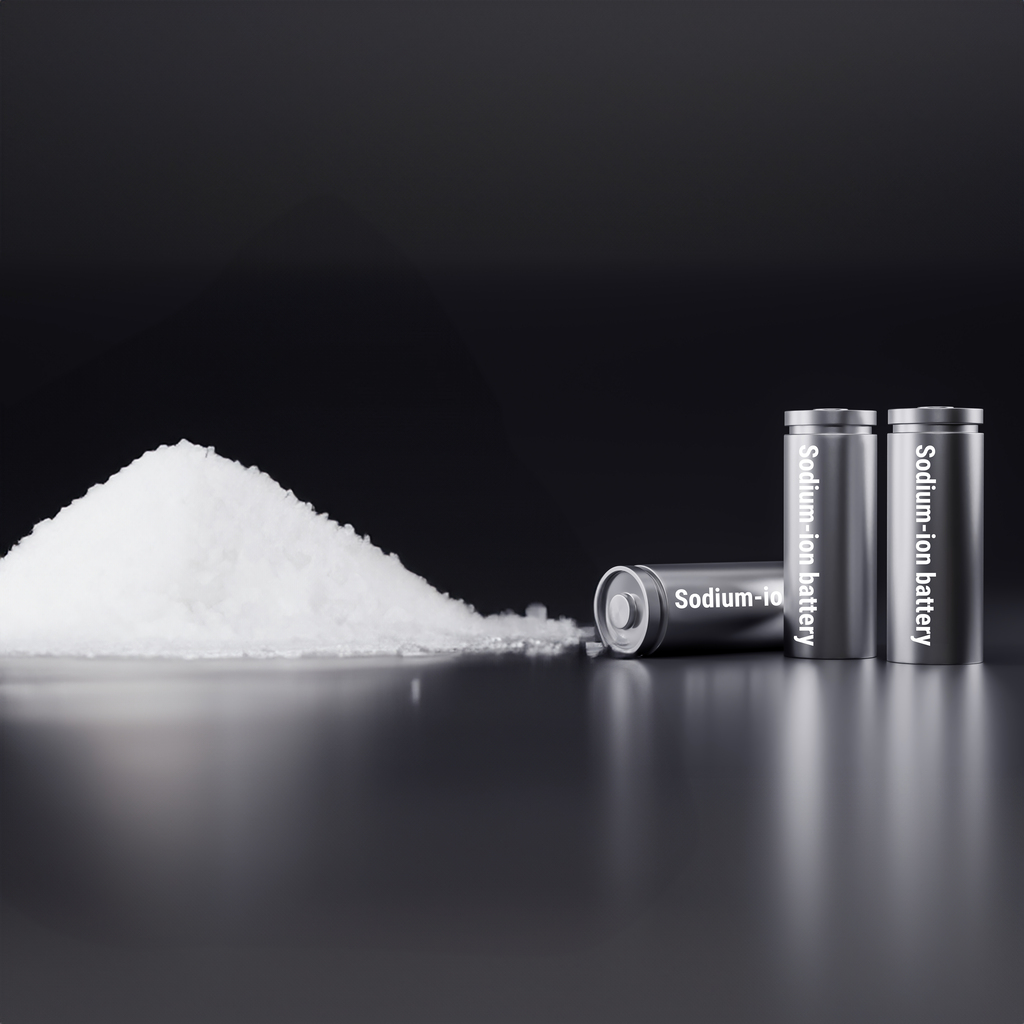
For more than a decade, lithium-ion has been the default chemistry for advanced batteries. But as demand for energy storage accelerates, many research teams are now asking a different question:
Could sodium-ion provide a more sustainable, lower-cost route for grid and stationary storage?
With sodium-based systems moving rapidly from lab discussion to practical development, reliable access to high-purity sodium-ion cathode materials is becoming critical. PI-KEM supports battery research teams across the UK and Europe with three sodium-ion cathode powders designed for serious R&D.
Why sodium-ion is attracting serious attention
Sodium doesn’t replace lithium in every scenario – but in the right applications it offers a clear set of advantages:
- Abundant and globally available – sodium is far more plentiful than lithium.
- Lower raw material costs – helping to improve project economics.
- Reduced supply chain risk – diversifying away from constrained, single-region routes.
- Potentially lower environmental impact – particularly for large-scale, stationary systems.
While energy density is typically lower than lithium-ion, sodium’s strengths lie elsewhere:
- Stability over long cycle life.
- Robust performance at larger formats.
- A good fit for grid and stationary storage, where footprint is less constrained than in EVs.
This makes sodium-ion an increasingly realistic candidate for:
- Grid-scale and community energy storage.
- Behind-the-meter commercial systems.
- Industrial backup and resilience.
- Research into future long-duration storage technologies.
Three new sodium-ion cathode powders now available.
Through PI-KEM, you can now access three distinct sodium-ion cathode materials, each with different structural and performance characteristics.
1. Na₂NiFeMnO₆– layered oxide for high specific capacity
Na₂NiFeMnO₆ is a layered oxide cathode with potential for high specific capacity, strong cycling stability and robust structural behaviour under repeated charge/discharge.
This combination makes it well suited for:
- Early-stage prototype cells.
- Comparative studies versus lithium-based layered oxides.
- Investigations into long-term stability for stationary storage formats.
2. Na₃Fe₂(PO₄)P₂O₇ (NFPP) – structurally stable, low-temperature performer
Na₃Fe₂(PO₄)P₂O₇, often referred to as NFPP, is a polyanionic phosphate material offering excellent structural stability, low volumetric change during cycling and good low-temperature performance.
It’s particularly useful when you need to understand:
- Dimensional stability over long cycle counts.
- How sodium-ion systems behave under varying temperature conditions.
- The trade-offs between energy density, rate capability and long-term robustness.
3. Na₄₊ₓFe₃₋ᵧ(PO₄)₂P₂O₇ (tuneable NFPP) – flexible composition ranges
Na₄₊ₓFe₃₋ᵧ(PO₄)₂P₂O₇ is a tuneable NFPP-type composition whose key advantage is flexibility.
Adjustable stoichiometry allows you to tailor redox behaviour, enabling focused control over capacity, voltage profile and cycling response. It is well suited to prototyping and fundamental studies where composition–performance relationships are critical.
If you’re working on next-generation sodium-ion prototypes, this tuneable material can be a useful platform for:
- Mapping composition versus performance.
- Optimising for specific stationary storage use-cases.
- Developing data sets for scale-up and future commercial evaluation.
Designed for real-world research, not just datasheets
In practice, the value of a cathode powder goes beyond its headline properties. For most labs and pilot lines, what matters is:
- Consistent quality from batch to batch.
- Real-world availability when projects move forward.
- Technical information you can rely on when designing experiments.
By working with LTS, we’re focused on providing high-purity, reproducible sodium-ion materials that fit academic and industrial research environments alike – from small-scale test cells through to early pilot validation.
How these materials support grid and stationary storage research
If your work is focused on grid and stationary storage, sodium-ion cathodes like these can help you:
- Explore trade-offs between cost, performance and stability.
- Model lifecycle economics using more realistic material inputs.
- Investigate cycling behaviour under grid-relevant duty profiles.
- Build prototype cells and stacks that more closely reflect future commercial systems.
For many organisations, sodium-ion is no longer a theoretical topic. It’s a practical route to:
- Reduce dependency on constrained raw materials.
- Design storage systems tailored to stationary applications.
- Build a technology roadmap beyond conventional lithium-ion.
Working with PI-KEM on Sodium-Ion Projects
As a specialist supplier to the battery research and advanced materials community, PI-KEM is set up to support teams who are:
- Starting exploratory sodium-ion projects.
- Benchmarking sodium against existing lithium frameworks.
- Developing prototypes for grid and stationary storage.
We can help you:
- Select the most appropriate sodium-ion cathode material for your application.
- Plan comparative studies across different structures.
- Combine sodium-ion materials with our wider range of battery research equipment and consumables.
Battery Materials & Chemicals | PI-KEM
Ready to explore sodium-ion?
If you’re evaluating sodium-ion as part of your energy storage roadmap, we’d be happy to discuss how these materials could support your work.
Email: sales@pi-kem.co.uk
Phone: +44 (0) 1827 259250
Web: Visit our Battery Research Materials section and search for sodium-ion cathode powders.
Or connect directly with our energy storage team via LinkedIn to discuss upcoming projects.
