


Research Round-Up: Raman Measurement and Modelling
Predicting the Vibrations of Lithium Niobate: Raman Measurement and Modelling with PI-KEM Y-cut and Z-cut Crystals
Reading a crystal through its vibrations
Raman spectroscopy is a valuable, fast, and non-destructive tool for studying crystals. By measuring how atoms vibrate inside a material, researchers can learn about its structure, identify chemical and structural defects, and determine how the crystal is oriented.
Increasingly, quantum mechanical simulations are being used alongside, or even as an alternative to, lab experiments. These computer models can predict where a crystal's Raman peaks appear (the frequency); however, predicting how strong each peak should be (the intensity) is more of a challenge.
Matching theoretical predictions to laboratory measurements – particularly the intensity of certain vibrational modes – would improve the ability of Raman spectroscopy to assess crystal quality, orientation and composition.
That is exactly what a 2022 study by Nogueira et al., published in the Journal of Raman Spectroscopy, set out to investigate using Y-cut and Z-cut lithium niobate (LiNbO₃) single crystals supplied by PI-KEM.
Find the full research paper here.
Bringing theory and experiment together
When light interacts with a crystal, it changes energy as it scatters. These energy changes reveal the crystal's vibrational modes, known as phonons.
Lithium niobate is a polar crystal, meaning it has a permanent electric dipole that influences how these vibrations behave, causing unique properties such as pyroelectricity and piezoelectricity. Some vibrations travel across the crystal, while others travel through it. These are known as transverse optical (TO) and longitudinal optical (LO) modes.
The two modes carry different information, but together their positions and relative intensities provide valuable information about a crystal.
Researchers can experimentally measure these vibrations using Raman spectroscopy. However, accurately predicting them from first principles computer models, particularly the LO modes, has traditionally been much more challenging.
The research team, working across the universities of Coimbra, Pau, Milan and Turin, tackled the problem from both experimental and theoretical directions at once.
Experimentally, the team used a micro-spectrometer with a 532 nm laser to record polarised Raman spectra from a PI-KEM-supplied LiNbO₃ single crystal.
Theoretically, they modelled the same crystal using density functional theory built on a linear combination of atomic orbitals (LCAO) and implemented in the CRYSTAL software package.
By comparing the simulations with the experimental results, the measured spectra acted as a benchmark to test the calculations, revealing how accurately the models reflected the real behaviour of the crystal.
The results showed that the simulated calculations matched well to experimentation.
Across thirteen computed TO and LO vibrational modes:
- Only two TO modes differed from experiment by more than 10 cm⁻¹
- Only four LO modes exceeded that margin
- Mean Absolute Error (MAE) on the full set of 26 modes was as small as 6.4 cm−1.
Overall, the simulations accurately capture the behaviour of lithium niobate, even for the more challenging LO modes.
Why the crystal quality matters
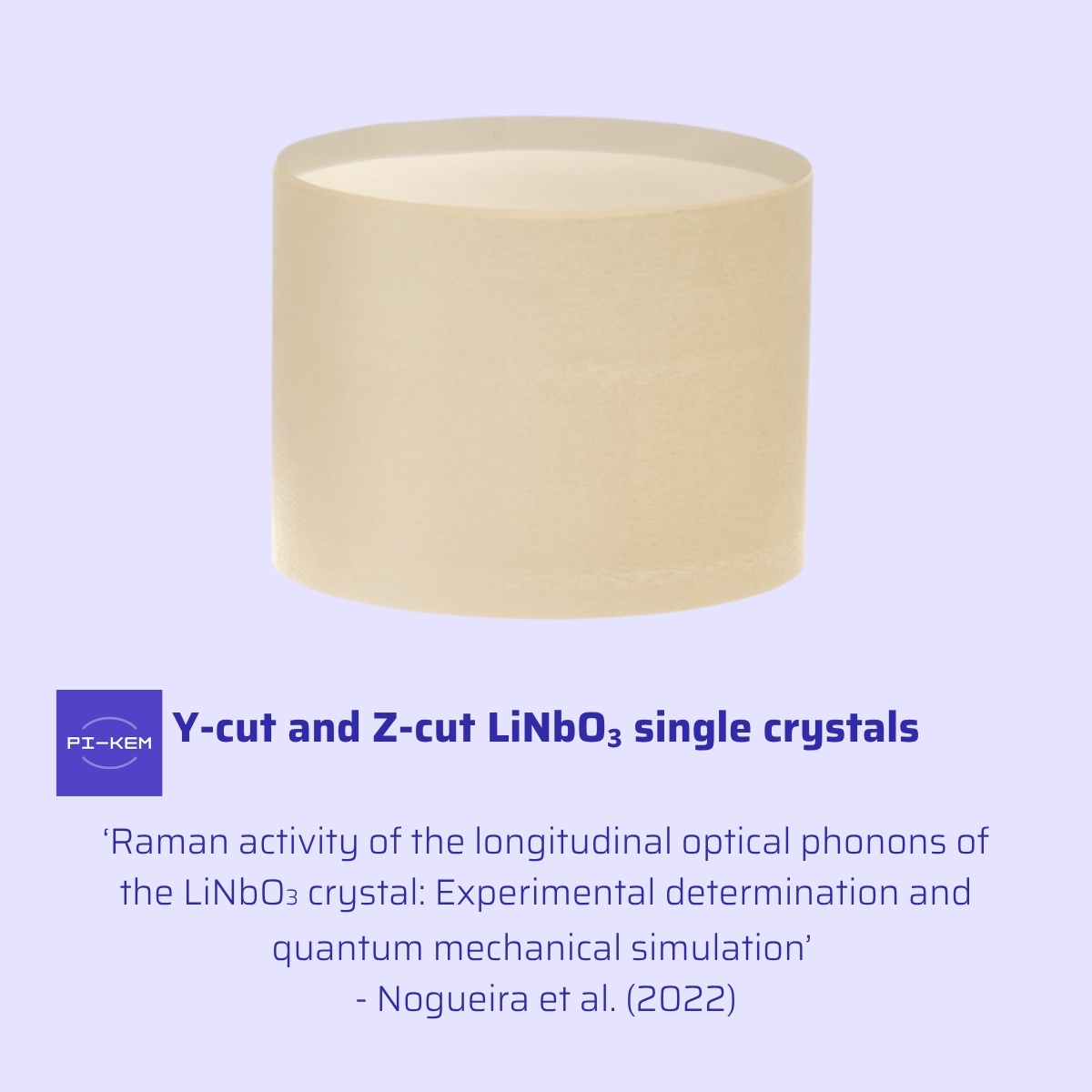
The study by Nogueira et al., rested on the quality of the samples: Y-cut and Z-cut LiNbO₃ single crystals (10 × 10 × 0.5 mm) supplied by PI-KEM.
Crystal orientation is especially important in polarised Raman spectroscopy. Different crystal faces reveal different vibrational modes, so using both Y-cut and Z-cut crystals allowed the researchers to measure the complete range of vibrations within the material.
Precisely-cut, high-purity and consistent crystals offer a dependable reference point when comparing experimental measurements with theoretical predictions. This helps researchers assess whether differences come from the computer model, or from the material itself.
Lithium niobate (LiNbO₃) itself is a versatile crystal, with applications across many technology sectors: converting electrical signals into optical ones to carry high-speed internet traffic, generating and filtering the acoustic waves that keep mobile phone signals clean, and manipulating laser light for emerging applications in quantum computing and sensing.
Understanding its vibrational behaviour helps researchers improve both existing devices and future technologies.
Importance beyond the lab
This paper delivered the first quantitative comparison of measured and predicted polarised Raman band intensities for lithium niobate's longitudinal optical modes.
More importantly, by providing not just the positions of LiNbO₃'s Raman bands, but also the intensities, it shows that modern quantum mechanical models can accurately reproduce what researchers observe in the laboratory – and for the right physical reasons. This gives scientists greater confidence when using these models to understand materials and develop new ones.
By experimentally validating the first principles calculation, this research also provides a template for future studies of other polar crystals, where the same experiment-and-theory pairing can help researchers test and improve their own phonon simulations.
Supporting research with reliable materials
By combining careful measurement, robust theory and precision materials, this work shows the importance of high-quality materials.
Reliable results begin with reliable materials.
The LiNbO₃ single crystals behind this study are part of PI-KEM's extensive single crystal range – available in standard formats, or grown and machined to your exact specification. Whatever your application, we're always happy to discuss your project and help you find the right material to build you next result.
Ready to discuss your requirements?
📞 Call our technical team on 01827259250
📧Email sales@pi-kem.co.uk
📝 Complete our online enquiry form
