


What's Next for Energy Research? Insights from Faraday 2026
The battery research landscape is changing quickly. New chemistries are evolving, manufacturing processes are being reconsidered, and greater attention is being paid to what happens to batteries and their materials at end of life.
The Faraday Institution conference brings together academics, researchers, manufacturers and suppliers from across the battery industry to share their research and discuss the direction of battery research.
As a Technical Specialist at PI-KEM, part of my role is understanding not only the technologies our customers are working with today, but where their research is heading next. This makes opportunities to hear directly from researchers particularly valuable.
PI-KEM has attended the Faraday conference for several years, but this year, while Colin Rouse and Lauren Rouse manned the PI-KEM stand, I had the opportunity to spend time in the presentations and panel discussions. I also really enjoyed seeing the talks captured through live illustration as the conference progressed. Watching the different ideas build into a visual summary was a great way to reflect on just how much was being discussed.
Across the conference, two areas particularly stood out to me: the growing diversity of battery technologies, and the need to think about sustainability, scalability and material supply much earlier in the research process.
1. There won’t be one battery of the future
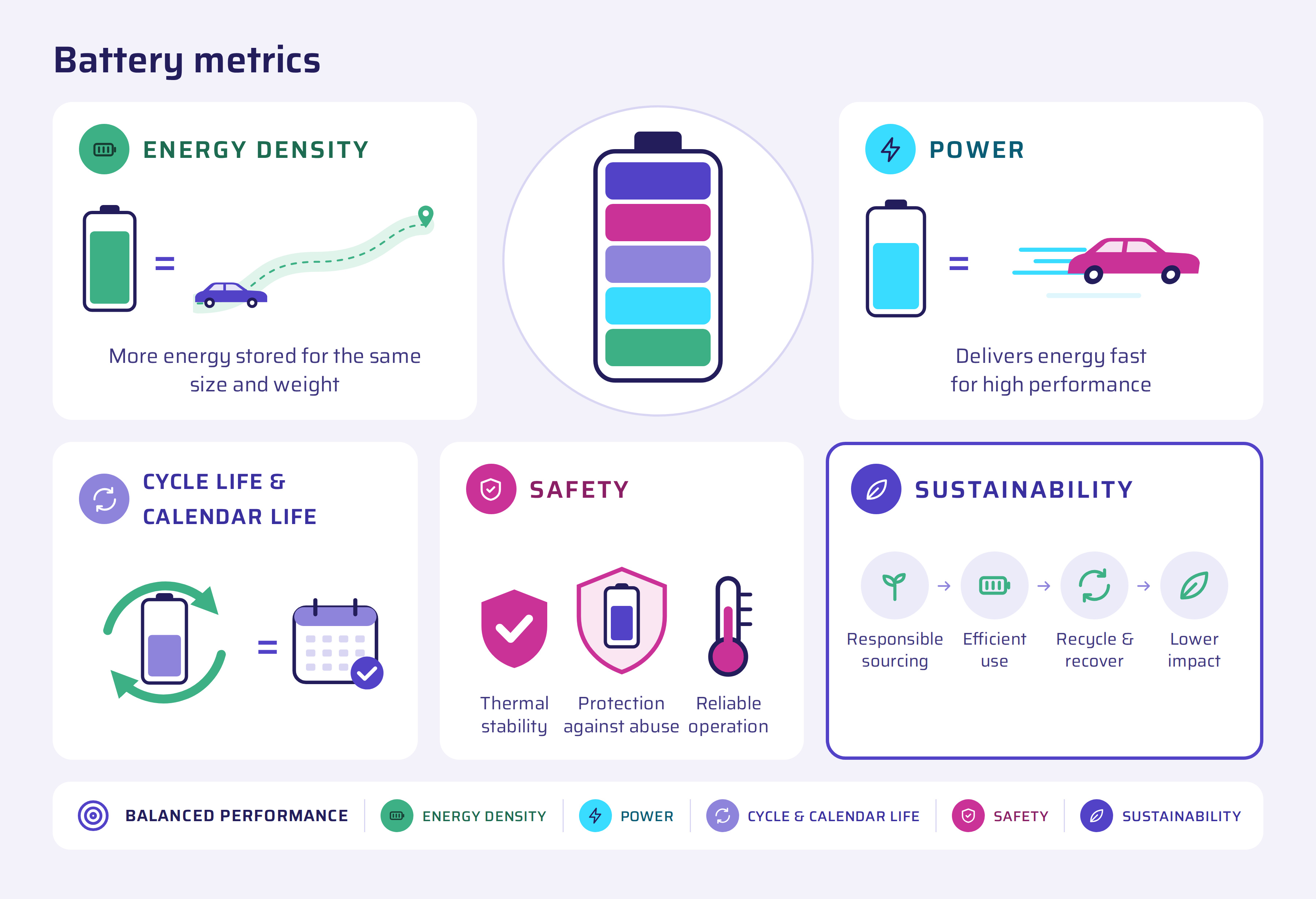
One of my biggest takeaways from Faraday was just how diverse the future battery landscape is likely to be.
There is no single set of requirements for the battery of the future. Different applications need different things from a battery. For one application, cost may be critical. For another, energy density, power, lifetime or safety may take priority. Material availability and the ability to manufacture a technology at scale add further considerations.
This means battery development is unlikely to converge on one universal chemistry. Established technologies will continue to improve while alternatives develop for applications where they offer particular advantages.
1.1. Evolving Chemistries
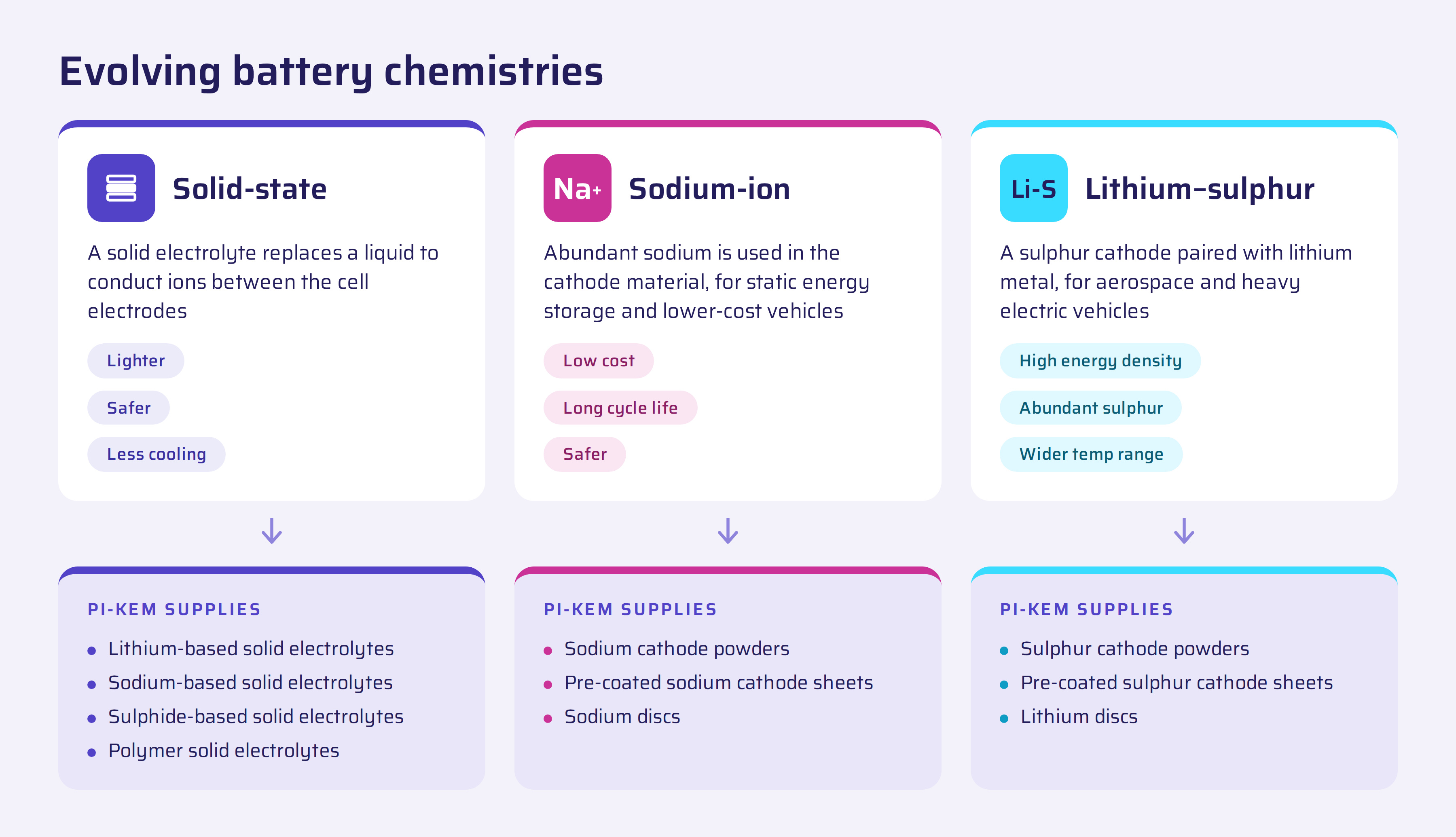
This diversity is already evident across Faraday’s current work. Next-generation programmes include solid-state, sodium-ion and lithium-sulphur batteries, while Transformational Challenges are exploring technologies for areas such as long- duration energy storage and very high energy density applications.
From my perspective, it is particularly interesting to consider what this means at a practical research level.
Greater chemistry diversity brings a wider range of materials requirements, processing conditions, cell designs and testing needs. Researchers may be working with very different materials and processes depending on the performance they are trying to achieve or the application they are trying to fit.
It reinforces why understanding the application and the wider research objective is so important when we speak to customers. There isn’t necessarily one material, piece of equipment or approach that will suit every project.
1.2 From promising chemistry to manufacturable cell
Another point that came through strongly for me was that electrochemical performance is only part of the challenge.
A material can perform well experimentally but create difficulties when you need to manufacture electrodes or cells consistently. Particle size, morphology, density, moisture and storage conditions can all influence how reliably a powder can be processed.
As research progresses, consistency therefore becomes increasingly important. Researchers need to understand whether a promising result can be repeated and whether the materials and processes behind it can eventually translate beyond an individual experiment. As someone within the scientific industry, I appreciate the need to reduce unnecessary variables wherever possible. Reliable material specifications and good batch-to-batch repeatability are therefore key to giving researchers greater confidence in their experimental results.
The talks also reinforced the importance of thinking about these practical requirements early. Novel research does not always fit an existing specification, so conversations around custom materials, equipment or processing requirements can be important to move a technology forward.
1.3. Manufacturing innovation is becoming just as important
One of the recurring messages I heard at Faraday was that improving chemistry alone isn’t enough if the eventual manufacturing process is too complex, expensive or difficult to scale.
Manufacturing processes need to become more efficient, sustainable and scalable.
Dry electrode processing was one example discussed at the conference, with the potential to reduce reliance on solvents and energy-intensive drying.
More broadly, new process routes seek to:
- lower energy use
- shorten processing times
- reduce the manufacturing footprint.
For me, this highlighted the importance of considering scale much earlier in research.
It is not simply a question of whether a technology works in the laboratory. Researchers also need ways to understand whether their process can be controlled, repeated and eventually scaled.
Equipment choices can therefore become important earlier than you might expect. If researchers can establish repeatable workflows for material preparation, electrode production, cell assembly and testing from the beginning, there is a clearer route for developing those processes to larger scales as the project progresses.
2. Battery sustainability is a systems challenge
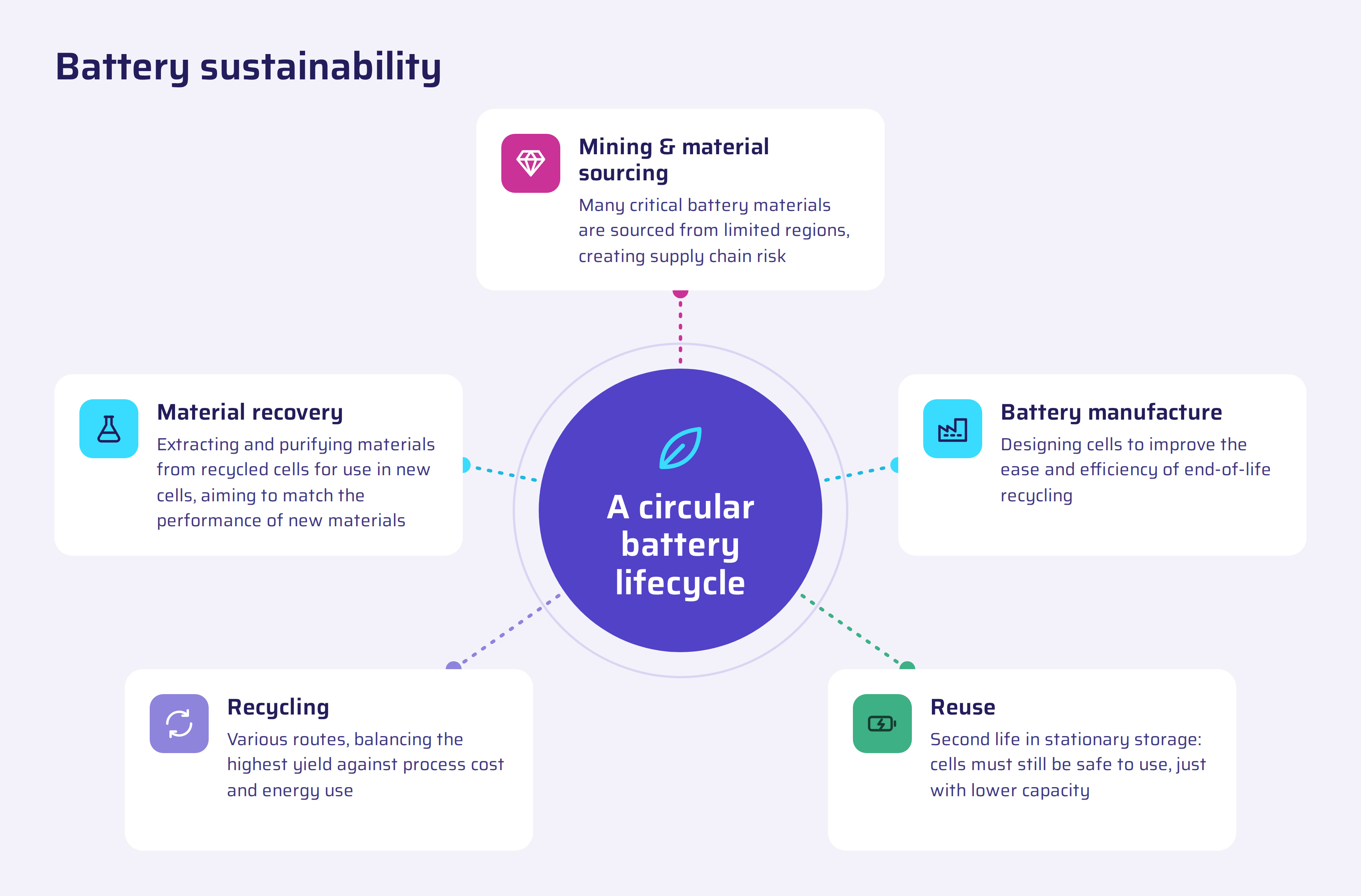
The second major area that stood out to me extended the discussion beyond how batteries are developed to what happens throughout their lives – and particularly at the end.
2.1. Reuse before recycling
One discussion I found particularly interesting was around when a battery really reaches its end of life.
An EV battery is typically considered to have reached end of life at around 70–80% state of health, but that doesn't necessarily mean it's ready to be sent to waste. Batteries can often remain usable down to 40–50% state of health in less demanding applications, such as stationary storage.
However, deciding whether a battery is suitable for a second-life application is more complicated than looking at state of health or age alone.
A full understanding of degradation mechanisms and safety criteria is key to determining whether a battery can be repurposed reliably. Chemistry, remaining capacity, second-life value, repurposing costs, recycling economics and recovered material value can all influence that decision.
What I took from this is the importance of having the data to make those decisions confidently. Testing and characterisation remain essential throughout the battery lifecycle, not only during initial development.
2.2. Recovering real value
When batteries do reach their final end of life, the focus increasingly turns to recovering as much useful material and value as possible.
For lithium-ion batteries, the typical recycling process involves discharging and shredding the cell, before isolating a mixture of anode and cathode materials known as ‘black mass’.
Traditional recycling breaks battery materials down significantly before recovering individual material components. Emerging approaches instead aim to retain the value created during manufacturing.

Direct recycling was particularly interesting in this context because it aims to retain more of the structure and value of battery materials. This can become relevant for chemistries where the constituent materials may make conventional recycling less economically attractive, such as for sodium-ion cells.
But recovery itself is not the end of the process.
Recycled material needs to be processed, characterised and validated before it can confidently return to battery manufacturing. Benchmark materials can be valuable here, giving researchers a consistent reference against which recovered or regenerated materials can be compared.
I think this also raises an interesting consideration for future research: rather than thinking about recycling only at end of life, could batteries be designed with their eventual recovery in mind from the very beginning?
2.3. Material supply needs to be part of the conversation
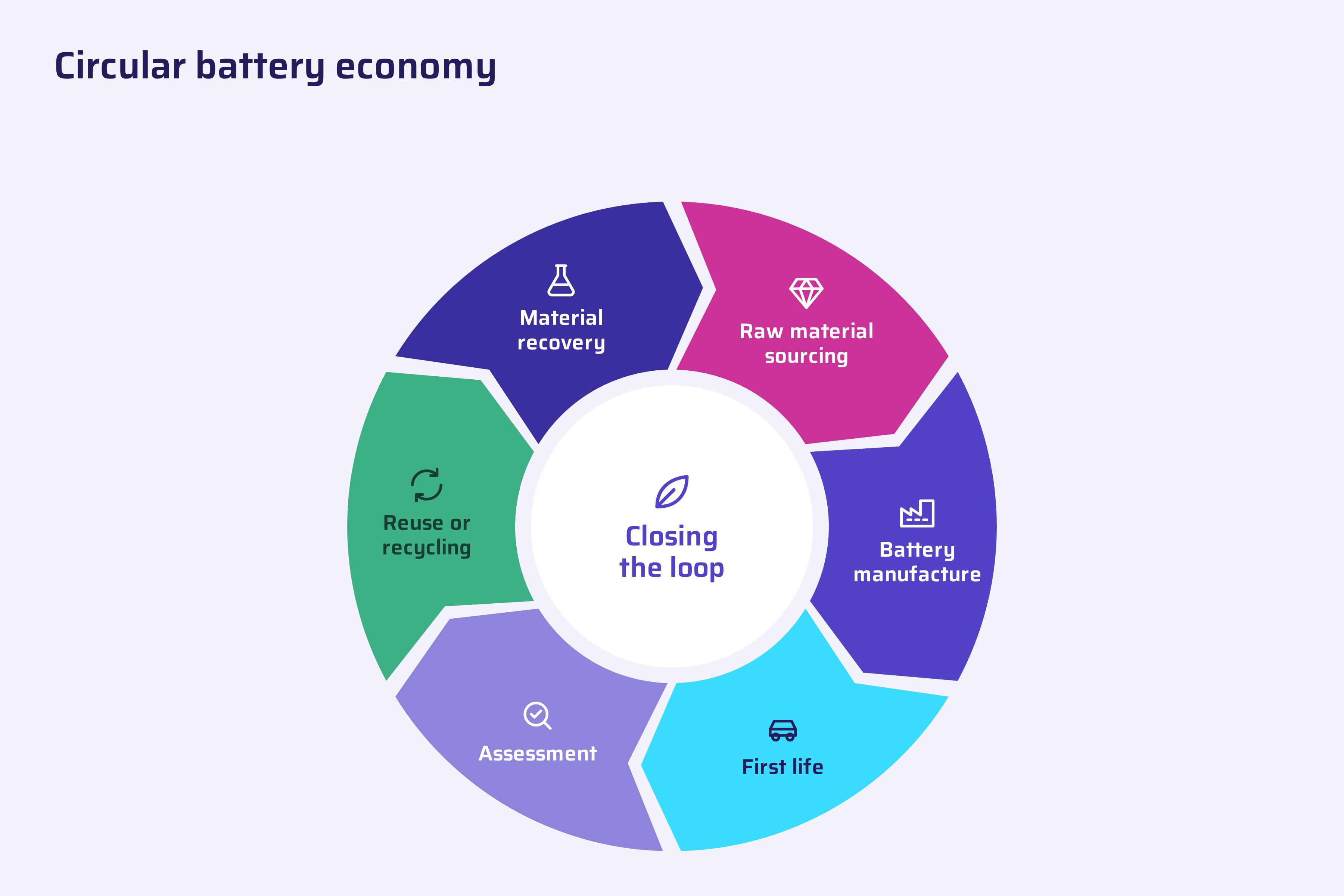
Over the course of the conference, it became increasingly apparent how closely sustainability and material supply are linked. Recovering and reusing battery materials isn’t only about reducing waste; it could also play an important role in building more resilient material supply chains.
Battery supply chains often depend heavily on a relatively small number of countries for the extraction, processing and manufacture of critical materials and battery components. This concentration can leave manufacturers exposed to disruption, trade restrictions and changes in material availability or cost.
Recovering and reusing materials could therefore provide an additional source of supply while reducing dependence on virgin materials and helping to close the loop on critical battery materials.
This also changes how we think about emerging battery technologies.
Performance will always be important, but material abundance, geographical availability and security of supply can also influence whether a chemistry can eventually move towards commercial production.
This is particularly relevant to PI-KEM. When we talk to researchers about a material, understanding its specification is only one part of the conversation. Availability, manufacturing capability, potential supply constraints and what happens if a project needs to scale can become equally important.
Thinking about those questions earlier can help identify potential barriers before a project reaches the point where larger quantities are required.
Collaboration will shape what comes next
The conference’s closing panel provided a fitting way to bring many of these discussions together.
Scientific novelty alone isn’t enough. New technologies ultimately need to solve a real problem and, as they develop, questions around manufacturability, scalability, cost, safety, material supply and commercial viability need to sit alongside electrochemical performance.
No single battery design can excel in every one of these areas.
For me, that reinforces why collaboration between academia, industry, manufacturers and the wider supply chain is so important – and why attending conferences like Faraday is so valuable.
It gives me the opportunity to step outside of individual product conversations and understand the bigger picture: what researchers are investigating, what is changing and where new requirements are beginning to emerge.
I can then bring that knowledge back to the wider PI-KEM team, to help shape and strengthen the conversations we have with our customers.
Battery research will continue to evolve, and the materials, processes and equipment needed to support it will evolve too. Being part of these discussions helps us keep pace with where the science is heading, so we can continue asking the right questions and help researchers identify what they need – both for the work they are doing now and where that work could take them next.
Taking your battery research to the next stage?
If your research is moving into a new chemistry, material, process or scale, speak to our battery team. From novel and customised materials to material processing, cell assembly, testing and pilot-scale equipment, we can help you explore what you need now and what you may need next.
Explore our full range of battery research equipment and materials online, contact PI-KEM on +44 (0)1827 259250, or email sales@pi-kem.co.uk to start a conversation with our energy research experts about your project requirements.
