


Ultrasonic Spray Coating: Precision Thin-Film Deposition from R&D to Production
Uniform, repeatable thin-film deposition is critical to device performance across applications including fuel cells, perovskite solar cells, semiconductors, sensors and medical devices.
PI-KEM supplies ultrasonic spray coating and spray pyrolysis systems through Navson, Cheersonic and MTI Corporation, covering compact R&D platforms through to pilot-production and high-throughput equipment. This range lets us match the right technology and configuration to your process, application and budget.
What does ultrasonic spray coating offer?
Conventional spray coating uses high pressure or compressed air to atomise liquid and fire the droplets onto a substrate. Common limitations:
- Overspray: material misses the target, increasing waste
- Inconsistent thickness: droplet size and distribution vary, affecting uniformity
- High droplet velocity: impact force can damage delicate substrates
These factors are particularly important when working with high-value functional materials, delicate substrates, or processes where coating consistency is critical.
Ultrasonic spray coating provides an alternative method of atomisation with a high degree of process control.
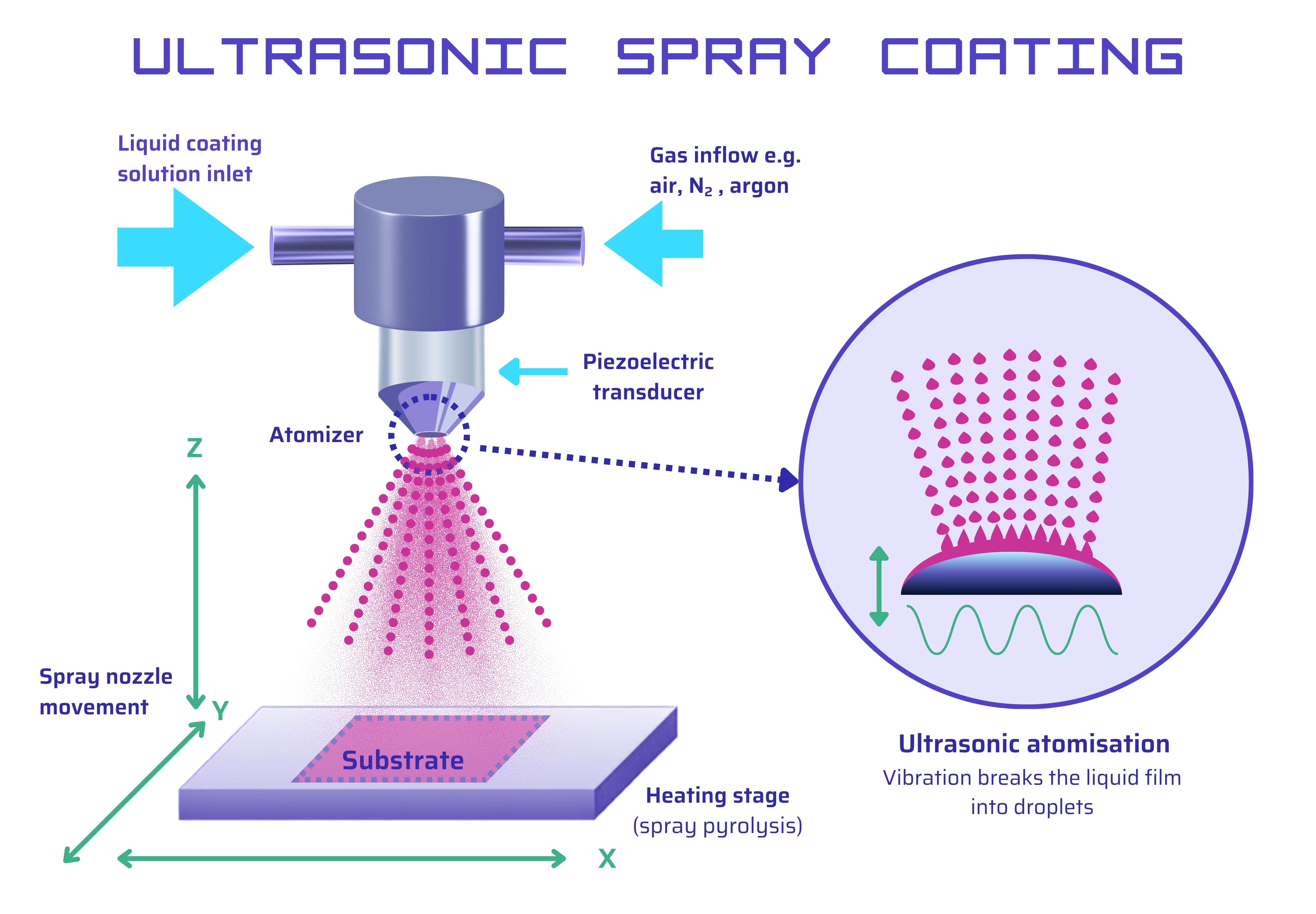
A piezoelectric transducer vibrates the nozzle, generating capillary waves that break the liquid into fine droplets. Higher ultrasonic frequencies produce smaller droplets; lower frequencies produce larger ones.
Droplets are directed onto the substrate under process control, adjustable via:
- Flow rate
- Nozzle selection
- Spray pattern
- Substrate movement
- Number of coating passes
The result is a soft, low-velocity spray with a high degree of process control.
Why consider ultrasonic spray coating?
What about ultrasonic spray pyrolysis?
For projects requiring thermal processing, ultrasonic spray pyrolysis combines atomisation with a heated substrate. A precursor is atomised, deposited onto the heated surface and, as the solvent evaporates, reacts to form the final material.
Key process parameters that affect the final film composition, thickness and morphology are:
- Substrate temperature
- Precursor chemistry and concentration
- Droplet size
- Deposition rate
- Nozzle-to-substrate distance
In powder metallurgy processes, spray pyrolysis can be used to produce nanoscale powders with controlled particle size, uniform distribution, spherical morphology and high purity.
Applications for advanced material processing
The flexibility of ultrasonic spraying has led to its adoption across a diverse range of research and manufacturing applications.
Tailoring equipment to your process
There is no single ultrasonic spray coating system that is right for every application. We start with your project goals.
.png)
The PI-KEM Portfolio
Working with Navson, Cheersonic and MTI Corporation allows PI-KEM to offer different approaches to ultrasonic coating and spray pyrolysis, from compact research systems through to specialised and continuous production equipment.
.jpg)

Discover full features and capabilities
Navson's NTPY01 provides a configurable platform focused on process control, repeatability and experimental flexibility. It combines ultrasonic atomisation with a PID-controlled heated substrate and programmable nozzle movement, giving fine control over droplet size, deposition conditions and film characteristics.
Additional key features include:
- Programmable X-Y motion with optional Z-axis control
- Approximate droplet sizes from 14 µm to 40 µm
- Air-ultrasonic atomisation options
- Heated substrate processing up to 500°C
- Touchscreen control with programmable recipes
- Process data logging to support repeatability and comparison between experiments
- Optional inert-gas purging and configurable sample fixtures
Cheersonic's portfolio spans compact benchtop systems through to standalone, large-area and continuous production equipment.
Additional key features include:
- Continuous and inline configurations for higher-volume processing
- Focused, fine-line, wide and vortex ultrasonic spray configurations
- Controlled liquid delivery and automated positioning
- Options for heated and substrate platforms
- Specialised equipment for applications such as stent and catheter coating, blood collection tubes / syringe coating, drug coatings, and photoresist coating
- Spray pyrolysis systems available for nanopowder production and atomisation/granulation

MTI's programmable benchtop and floor-standing systems combine controlled spraying with heated substrate platforms; more specialised configurations support different materials, geometries and processing methods.
Additional key features include:
- Roll-to-roll, sheet coating and high-throughput systems for high-volume and continuous processing
- Spin-spray systems for wafers and circular substrates
- Systems for cylindrical surfaces and high-viscosity slurries
- Flame-assisted spray pyrolysis
- Modular components for customised research setups, including:
- Power controller
- Programmable motion stage
- Range of nozzle geometries and frequencies
Choosing the right ultrasonic spray coating system
Common reasons for investigating ultrasonic spray coating include coating uniformity issues, material waste levels, difficult substrate geometry, a repeatability requirement, or a process moving beyond lab scale. In each case, we start with the same four questions:
- What issues are you currently having?
- What are you depositing?
- What are you coating?
- What does the resulting film need to achieve?
If you're exploring ultrasonic spray coating or spray pyrolysis, contact our specialist equipment team at PI-KEM. They'll help you explore the equipment options and identify an approach that fits your materials, processes and future plans.
